
Tag: Aljazeera News.


Ethiopia PM claims major advance in Tigray region
Ethiopian: CeelWaaqNews, With communications down and media barred, independent verification of the status of the conflict was impossible.
![Members of the Amhara region armed group head off to fight the Tigray People's Liberation Front [File: Tiksa Negeri/Reuters]](https://www.aljazeera.com/wp-content/uploads/2020/11/2020-11-12T143336Z_1730492674_RC2Q1K9J52UA_RTRMADP_3_ETHIOPIA-CONFLICT-DEBRETSION.jpg?resize=770%2C513)

Ethiopia’s prime minister has claimed that the Western Tigray region has been “liberated” after a week of fighting, while United Nations agencies warn of a dire humanitarian situation worsening by the day.null
“The Western region of Tigray has been liberated,” Ethiopian Prime Minister Abiy Ahmed said on Twitter on Thursday. UN fears Ethiopia refugee emergency, warns of aid being blockedEthiopia’s Tigray conflict explained in 500 words Sudan braces for up to 200,000 fleeing Ethiopia fighting
“The army is now providing humanitarian assistance and services. It is also feeding the people,” he said.
With communications down and media barred, independent verification of the status of the conflict was impossible.
Fears over a spiralling conflict are mounting since the federal government’s decision to embark last week on a military campaign after it accused the Tigray People’s Liberation Front (TPLF), which rules the mountainous northern state, of attacking sections of federal military stations.null
“The fighting is still going on between ground troops on both sides, with air strikes targeting fuel and arms depots that have caused significant casualties on both sides,” said Al Jazeera’s Mohammed Adow, reporting from the capital Addis Ababa.
“The government said it will not stop the operation until it reaches its objectives of ensuring that TPLF are disarmed, their leadership brought to justice and any fugitives apprehended,” Adow said.Volunteers gather to donate blood for the injured members of Ethiopia’s National Defense Force [Tiksa Negeri/Reuters]Abiy said some of his soldiers had been found dead in the town of Sheraro, shot with their legs and arms tied behind their back.
“This kind of cruelty is heartbreaking,” he said. He did not say how many bodies were found or provide proof.
Why Somalis are closely watching the US elections
Impacted by the US’s ‘war on terror’ and Trump’s so-called Muslim ban, many in Somalia await result of November 3 polls.
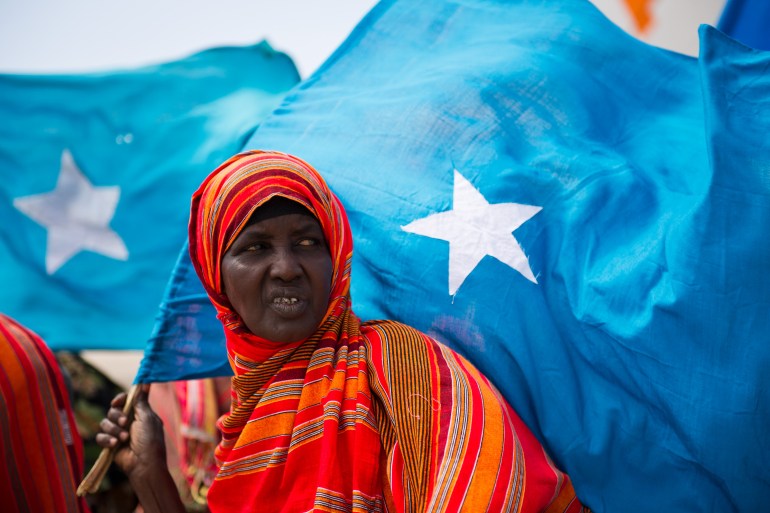
By Hamza Mohamed1 Nov 2020
Just as people across the United States will be waiting eagerly for the results of Tuesday’s voting, thousands of kilometres away, on the far eastern corner of Africa, Somalis will also be closely watching the hard-fought matchup between Donald Trump and Joe Biden.
It hardly comes as a surprise. A country of some 15 million people, Somalia has for decades felt the impact of US policies – both directly and indirectly.
“Ever since Somalia got independence in 1960, America and its leaders have tried to have a strong foothold in the country,” said Hassan Sheikh Ali, a lecturer of international relations at Somali National University.
The main reason? Somalia’s “strategic location”.
Bounded by the Indian Ocean to the east and the Gulf of Aden to the north, the Horn of Africa country occupies a significant geopolitical position along major trade routes. Up to 30,000 ships, carrying goods from crude oil to iron ore, pass annually through the Gulf of Aden, a key transit zone for maritime traffic between the Indian Ocean and the Mediterranean Sea.
“America is in Somalia to protect its commercial interest,” said Hassan. https://players.brightcove.net/665003303001/A3nzcwywTg_default/index.html?videoId=4818159346001&playsinline=true
The US’s engagement in Somalia remained steadfast throughout the Cold War when it competed with the Soviet Union for influence and control. “Somalia first sided with the West, then the USSR, before switching sides yet again in the 1980s and going with the West,” said Hassan.null
In the late 1980s, Washington deployed military aid and trainers to stem the tide of a rebellion threatening the government of autocratic ruler Siad Barre.
But in 1991, after 21 years in power, Siad was overthrown by rival clan militias. As fighters ransacked the country, the US closed its embassy in Somalia’s capital, Mogadishu, and watched from afar as chaos reigned.
The next year, Somalia was hit by a severe drought that led to a catastrophic famine. The militias pillaged whatever little resources the country had, including international food convoys that had arrived as part of a United Nations-led humanitarian effort.
In late 1992, as hundreds of Somalis died of starvation and thousands more were on the brink, the UN approved a proposal by then-US President George H W Bush to deploy US combat troops with the goal of protecting aid workers.
 Ceelwaaq News